

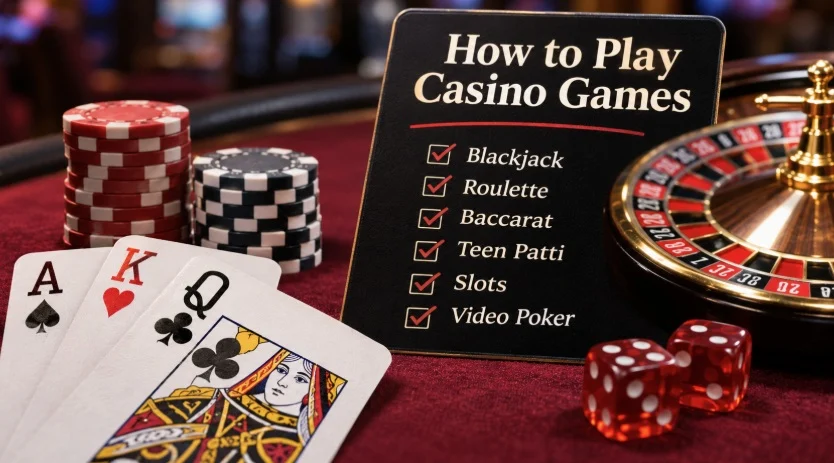
Watch a poker player approach a blackjack table for the first time. They may know how to calculate pot odds, recognize betting patterns, and manage a bankroll. Yet none of those skills tells them whether to hit a hard 16 against a dealer’s ten.
Casino games often use familiar cards, chips, and betting terms, but their rules can be surprisingly different. In poker, players compete against each other. In blackjack, they face a dealer who follows fixed instructions. In roulette, the outcome depends on where a ball lands.
Before placing a bet, it helps to understand three things: how a game works, which decisions matter, and how the casino makes its money.
Start With the Rules, Not the Betting Table
Most casino games fall into three broad categories: table games, slot machines, and poker-style games. Each offers a different experience.
Blackjack involves decisions that affect the mathematical outcome. Roulette and baccarat require players to choose a wager, but offer little control once the round begins. Poker and certain three-card games introduce betting decisions based on incomplete information.
The first question should be simple: are you competing against the casino or other players?
In house-banked games, the rules and payouts generally give the operator a mathematical advantage. In poker, the casino usually earns money through rake or tournament fees, while players compete for the remaining funds.
Knowing the difference prevents a common mistake: assuming that a strategy that works in one card game will also work in another.
Teen Patti: Three Cards and a Different Betting System
Poker players exploring Asian card games will eventually encounter Teen Patti.
The game is particularly popular in India and other parts of South Asia. Its name means three cards, and its structure resembles three-card brag.
Unlike blackjack or baccarat, traditional Teen Patti is played between participants competing for a shared pot.
A standard teen patti online game usually retains the familiar three-card hand rankings and betting terminology, although digital versions may introduce different table limits, side bets, or house rules.
How a Teen Patti Round Works
Each participant contributes an initial stake known as the boot. The dealer then gives everyone three cards face down.
Players can remain blind, meaning they have not looked at their cards, or play seen after examining their hands.
The betting process revolves around several actions:
- Blind: Continue betting without examining your cards.
- Seen or Chaal: Play after viewing your cards and contribute the required stake.
- Pack: Fold and leave the current hand.
- Side show: Request a private comparison with another eligible player, where the rules allow it.
- Show: Compare the remaining hands to determine the winner.
Blind and seen players often face different minimum betting requirements. The precise amounts and conditions depend on the version being played.
Teen Patti Hand Rankings
The traditional hierarchy resembles poker but contains important differences.
| Rank | Hand | Example |
| 1 | Trail or Trio | A-A-A |
| 2 | Pure Sequence | 7♠-8♠-9♠ |
| 3 | Sequence | 4♠-5♥-6♦ |
| 4 | Color | A♥-J♥-7♥ |
| 5 | Pair | K♠-K♦-3♣ |
| 6 | High Card | A♠-J♦-8♣ |
A pure sequence combines three consecutive cards of the same suit. A regular sequence uses consecutive cards without requiring matching suits.
A color contains three cards of the same suit that do not form a sequence.
Unlike conventional five-card poker, a three-card sequence ranks above a three-card color.
Some variations also change how A-2-3 is ranked, so checking the specific rules matters.
Does Poker Strategy Work in Teen Patti?
Certain skills transfer well.
Understanding hand strength, watching opponents, and controlling bet sizes are useful in both games.
However, Teen Patti has its own betting structure. The option to play without viewing your cards introduces decisions that have no direct equivalent in ordinary Texas Hold’em.
A player holding a strong pair may still lose to a higher pair, sequence, or trail. Conversely, a weak hand can sometimes win when every opponent folds.
As in poker, the result depends on both the cards and the decisions made before the showdown.
One distinction is particularly important online: traditional multiplayer Teen Patti should not be confused with dealer-banked casino variations carrying similar names. The betting rules and payout structures may be entirely different.
How to Play Blackjack
Blackjack is a useful starting point because its rules are straightforward, but players still have meaningful decisions to make.
The objective is to finish with a hand closer to 21 than the dealer’s without going over.
Number cards retain their face values. Kings, queens, and jacks count as ten, while aces count as either one or eleven.
A typical round follows this sequence:
- Place a wager before the cards are dealt.
- Receive two cards while the dealer reveals one card.
- Choose whether to hit, stand, double down, or split, where permitted.
- The dealer completes their hand according to the table rules.
- Winning and losing wagers are settled.
Why the Dealer’s Upcard Matters
Suppose you hold 12 against a dealer showing a six.
Taking another card might seem tempting because your total is relatively low. However, standard basic strategy generally recommends standing with a hard 12 against a dealer’s six.
The reason is that the dealer has a relatively high chance of busting when starting with a weak upcard.
Now change the dealer’s card to a ten. Hitting becomes the usual basic-strategy choice.
Your hand has not changed, but the best decision has.
This is why blackjack strategy charts are useful. They describe mathematically preferred actions for specific table rules rather than relying on intuition.
One detail deserves particular attention: the payout for a natural blackjack. A 3:2 table is substantially more favorable than an otherwise identical 6:5 table.
Roulette: Learning What the Bets Actually Pay
Roulette requires fewer decisions than blackjack.
Players place chips on a numbered betting layout before the dealer spins the wheel. When the ball settles, winning bets receive payouts based on their type.
European roulette has 37 pockets numbered from zero to 36. American roulette has 38 because it adds a double zero.
That extra pocket changes the mathematics.
The standard house edge is approximately 2.70% on a European single-zero wheel and 5.26% on an American double-zero wheel, excluding special rule variations.
Inside and Outside Bets
An inside bet covers a specific number or small group of numbers. A straight-up bet on a single number pays 35:1.
Outside bets cover larger groups, such as red or black, odd or even, or one of the three dozens.
A red bet pays even money, but it does not have a 50% chance of winning on a European wheel. The green zero prevents that.
The probability of winning a red bet is 18 out of 37, or approximately 48.65%.
A smaller payout does not automatically make an outside bet mathematically better. Under standard European rules, most conventional wagers carry the same house edge.
The difference lies in how frequently they win and how much they pay.
Baccarat: Understanding Player and Banker
Baccarat looks formal, especially in high-limit casino rooms, but the actual gameplay is simple.
Two hands are dealt: Player and Banker.
The objective is to predict which hand will finish closer to nine.
Cards from two through nine retain their values. Tens and face cards count as zero, while aces count as one. Only the final digit of the total matters.
For example, a hand containing eight and seven has a baccarat value of five.
Players normally choose between three wagers: Player, Banker, and Tie.
Once betting closes, the dealer follows fixed drawing rules. Players do not decide whether either hand receives another card.
The Difference Between the Main Bets
In standard commission baccarat, the Banker bet has a house edge of approximately 1.06%, while the Player bet has an edge of approximately 1.24%.
The Tie bet is much less favorable when it pays 8:1, carrying an edge of roughly 14.36% in an eight-deck game.
Some baccarat variants remove the traditional commission but change the payout on certain Banker wins. Those rules must be checked separately.
Baccarat also creates an interesting psychological trap. Many tables display long records of previous results, sometimes called roads.
These patterns can look meaningful, but previous hands do not provide a dependable prediction of future outcomes.
A sequence of five Banker wins does not mean Player is due to win next.
Slot Machines: Understanding Reels, Paylines, and RTP
Slots differ from table games because players generally make no strategic decisions during the outcome of a spin.
A player selects a stake and starts the game. The random number generator determines the result according to the game’s mathematical design.
Modern slots may include expanding symbols, free spins, multipliers, and bonus rounds.
These features change the way winnings are distributed, but they do not allow players to predict future results.
What RTP Actually Means
Return to Player, or RTP, represents the theoretical percentage of wagers returned to players over a very large number of game rounds.
A slot with 96% RTP has a theoretical house edge of 4%.
That does not mean someone wagering $100 will receive exactly $96 back.
One player might finish with nothing, while another could win several times their original stake.
Volatility helps describe how wins are distributed. High-volatility games typically produce larger swings, while lower-volatility games tend to distribute returns more evenly.
The actual RTP configuration should be checked in the game’s information panel because some titles operate with multiple mathematical versions.
Video Poker: Where Card Knowledge Makes a Difference
Video poker looks like a slot machine, but its underlying gameplay is closer to draw poker.
The player receives five cards and chooses which to keep. The discarded cards are replaced, and the final hand is evaluated against a fixed paytable.
Unlike multiplayer poker, there is no opponent to bluff.
The main challenge is choosing the correct cards to hold.
Consider a hand containing four cards to a royal flush alongside a low pair.
Keeping the pair guarantees a modest starting combination, but holding the four royal cards may offer better expected value depending on the exact cards and paytable.
Video poker strategy is built around comparing those possibilities.
Why the Paytable Changes Everything
Two machines displaying the same game name can offer different returns.
In Jacks or Better, for example, a full-pay 9/6 version awards nine credits for a full house and six for a flush, assuming a one-credit base payout scale.
With optimal strategy, the conventional five-credit version has a theoretical RTP of approximately 99.54%.
Reduced payouts for full houses or flushes can significantly lower that figure.
Video poker is therefore one of the clearest examples of why checking game rules matters more than choosing a visually attractive machine.
The Mistakes That Cost Beginners Money
Different casino games encourage different errors, but several mistakes appear repeatedly.
Treating Every Win as Proof of a Good Decision
A player who stands on a hard 16 against a dealer’s ten might win when the dealer busts.
That result does not prove standing was the better mathematical choice.
Likewise, a roulette player who wins after doubling a previous loss has not demonstrated that the betting system works.
Individual outcomes cannot reliably measure the quality of a strategy.
Ignoring the Cost of Each Round
A game with a relatively low house edge can still become expensive when played quickly.
Consider a blackjack table with a 0.5% theoretical house edge under the player’s strategy.
At an average wager of $10 across 60 hands, the total amount wagered is $600. The theoretical expected loss is approximately $3.
At 300 hands, total wagering reaches $3,000, increasing the theoretical expected loss to $15.
Actual results can vary considerably, but the example shows why playing speed matters.
Confusing a Larger Payout With Better Odds
A roulette bet paying 35:1 appears more rewarding than an even-money bet. However, it wins much less frequently.
The same principle applies to baccarat Tie bets and many casino side bets.
A generous-looking payout is only one part of the calculation. Its probability must also be considered.
Which Casino Game Should You Learn First?
The best starting point depends on whether you prefer making decisions or watching outcomes unfold.
| Game | Difficulty | Main Decisions | Useful Starting Knowledge |
| Blackjack | Moderate | Hit, stand, split, double | Basic strategy |
| Roulette | Easy | Select betting positions | Wheel type and payouts |
| Baccarat | Easy | Player, Banker, or Tie | Hand values and house edge |
| Teen Patti | Moderate | Blind, seen, bet, fold | Hand rankings and table rules |
| Slots | Easy | Stake and optional features | RTP and volatility |
| Video Poker | Moderate | Which cards to hold | Paytables and hand strategy |
For someone familiar with poker, blackjack and video poker provide interesting mathematical challenges.
Teen Patti offers a more social form of card competition, with betting decisions and opportunities to observe opponents.
Baccarat and roulette appeal to people who prefer straightforward rules with limited decision-making.
These differences are more useful than trying to identify one universally superior casino game.
A Better Way to Approach Your First Session
The easiest way to learn a casino game is to separate the rules from the money.
Start by reading the paytable and identifying the decisions available. If a free demonstration is available, use it to understand the sequence of play before considering real-money wagering.
For blackjack, practice applying basic strategy to different starting hands. For roulette, compare the probabilities behind inside and outside bets. For Teen Patti, become familiar with the betting terminology and three-card rankings.
Set a fixed entertainment budget and avoid increasing stakes to recover losses. No progression system or short-term pattern can eliminate the mathematical advantage built into house-banked games.
The same principle experienced poker players apply to bankroll management remains relevant: one session should never determine how much money you can afford to risk.
Casino games become much easier to understand when their rules, decisions, and costs are examined separately. Blackjack rewards mathematical discipline. Teen Patti combines hand rankings with betting judgment. Roulette and baccarat leave most outcomes to chance.
Learning those differences will not guarantee a winning session, but it will help you understand exactly what is happening when the cards are dealt or the wheel begins to spin.